Monday, 26 February 2018

Survey Time!

Hi everyone, please take the time to complete my survey for my inquiry!

Any comments/thoughts/suggestions are much appreciated! If you would like to be interviewed let me know!

Thank you in advance!

Tuesday Discussion Skype 20th February 2018

Last Tuesday, a small group from all modules joined Helen to discuss a number of topics where we felt we needed help and/or more clarity.

Literature

This mainly came from module 3 students (myself included). How we incorporate literature seemed to be the biggest query. Helen made it very clear that when looking at literature we shouldn't just 'look for the answers we want'. The point of reading a wide range of literature is so we have an understanding of the field in which our inquiry belongs.

Helen describes it as a party.
You (the host) invited the guests (the literature) the guests mingle with each other (they may have some share knowledge but may not all get along) from this You can get their views (buy reading the literature) and from that you form your own view and opinion.

Important point to remember as you host your 'party' keep note (Harvard reference) of all those who made you form a view or make you ask questions.

One literature review should contain lots of difference sources/resources/literature. 

Don't look at literature as two sides (those that agree with your inquiry and those that don't) Look at it as three dimensional. A body of voices to open a discussion (the party!).

Analysis

This is what I really wanted to talk about but unfortunately we only touched on the subject briefly. Never the less, I learnt that analysis is my role as the researcher - I am making the cross overs between points.

'I've read this and this, my data shows this.' My analysis is of the cross over between all of it or lack there of and how it fits with my inquiry. I would love to hear some other ideas about analysis and I still feel like its a bit of a grey area for me.

To end this post, an important quote from Helen herself:

'You're not trying to re-invent the wheel - you're trying to contribute to it'

So I roll onto survey making and interview undertaking. 

Monday, 12 February 2018

And Thus, Module 3 Began...

It seems that some time has passed since my last blog post. So, a quick catch up with what's been going on.

Towards the end of Module 2 a bit of panic set in, to begin with I did the final assignment completely wrong and spent a solid day typing and re-writing ready for the 'final marked hand in date'. Whilst this panic wasn't pleasant at the time, it did get the work done and ready for the real final submission on January 5th. I was so busy working on my proposal that blogging took a backseat.

Panto season has come and gone. Due to the huge amount of work that I was involved in over the festive period, I'm glad I got our assignment done earlier - it gave me time (the little spare I had) to edit and re-draft. This echoes a point on Adesola's latest blog: set the finish date earlier than it actually is, allowing yourself that little extra time at the end.

A few weeks ago I also attended the Module 3 presentation on campus, to get a better understanding of what I would be doing come June time. Two important points that I noticed came up quite frequently were:
1) How what I have discovered through my inquiry applies to me and my practice
and
2) What have I gained from this inquiry?

I think the danger with the inquiries is getting bogged down with trying to answer our 'big question' (which was brought up in a previous campus session) and I need to remember how my inquiry is relevant to my practice.

Where to go from here?
My inquiry title is  
Does working in technical theatre enhance and advance your skills as a performer?’

Here's a quick list of what I'm beginning to do:
- Complete feedback form
- Read Module 3 Handbook and annotate where I need
- Continue my search for literature for my inquiry - review these in relation to my inquiry
- Get organised
- Think about ideas for my artefact
- Communicate with my designated tutor and SIGs more

I aim to attend as many campus and skype sessions as I can, but we all know how difficult it can be with such busy work schedules. But unto the depths of Module 3 we must ride. Hazaar!


Wednesday, 22 November 2017

SIG - Sitting In Gnomeland

Now that I have your attention, I wanted to take some time to talk about how valuable SIGs are.

SIG - Special Interest Group

When I began Module 2, I remember thinking to myself  'what on earth is a SIG?' I had seen them mentioned left, right and centre. I have previously written about how finding and participating in SIGs was initially very difficult, for an array of reasons such as time and not knowing my inquiry question. However, it is because of these groups that I discovered what I wanted my inquiry to be.

Throughout my time on this course, not only do I read the blogs of students on the same module as me, but also those on all other modules and past students. I have found it incredibly helpful if I'm stuck or looking for a bit of inspiration. So in the hope of a future student reading this 1) Hello and welcome 2) don't see the SIGs as an immediate right off, they're worth it I promise.

So why have I found them so valuable? Well here's a quick list:

- They offer support and encouragement
- They can be a fresh set of eyes that you need, when you have been focused for too long
- A good source for discussion whether it be for your inquiry or otherwise
- More opinions give you more to consider and talk about
-  It is a good way to discuss the course and provide more professional connections
- It's a constant stream of communication which keeps you thinking about the course

So, thanks to the SIGs I found my inquiry title. Instead of listening to the millions of ideas whirring around inside my head, I listened to others who were looking onto my practice and work. Equally, the blogs are a fantastic discussion and conversation source, but using the comment function can be hard to keep a running conversation going, so the SIG does this brilliantly.

Throughout my Inquiry, I aim to use my current, and hopefully new, SIGs efficiently as a tool to aid my investigation.

Tuesday, 21 November 2017

The Cirle of Life of My Inquiry

So, I have actually been hard at work developing my inquiry but I haven't had the time to blog about it. Thought I'd do a quick summary of what's been going on.


I have been struggling with what I want my inquiry question to be for a long time now. My brain has flitted between a million different ideas. My blog posts are very good evidence for that. I know that I tend to over think and over evaluate things, so when I think about it my inquiry question has been right in front of me the whole time.

It took a few SIG conversations for me to come to the realisation that whilst all the 'possible inquiry questions' I have written about are interesting, they're not necessarily involved with my daily practice.

Adesola would constantly say 'Yes, but what is your practice?' and I would get flustered and confused. A brain overload between all the skypes and reading and blogging. I'd forgotten to look right at the heart of what I do.

'Hi, my name is Jess Dinmore and I'm an actor, currently working as a theatre tech'.

That is my practice. I love my job and the incredible team of people I get to work with but I started to think about WHY I love working backstage so much. I decided to jot down a few ideas in my journal from Module 1:


It was that last point that really struck a chord home. What exactly are the skills I have learnt and how can I bring them into the performing world. Thus my inquiry title was born. 

 'Does working in technical theatre enhance and advance your skills as a performer?'

The only way I can describe how it felt to finally have made a decision on my inquiry title and how inspired and excited I was and still am about looking further into it, is by this image:


I'm fortunate enough to be a part of a few SIG groups, so I pitched the idea to them when it was still in the early stages. I was (rather thankfully) greeted with positive remarks:


I have completed my basic inquiry plan with all my intentions mapped out. My next immediate step is to start looking further into literature to read, then write reviews on said literature. I'm excited to see what my inquiry will bring.


Someone get me a brew.

Monday, 30 October 2017

Tasks 5A, 5B and a little bit of 5C

Ethics in my work place was a bit of a strange one to approach. I'm not currently what people would call an 'active' actor. What with my busy work schedule and all this uni work I have set that aside until I have time for auditions and what not. So, I have done list based around working as a theatre crew member.


I think a lot of these disciplines cross over with those you have when you are performing/acting. Although the two jobs are very different, I feel there is a basic set of values that we all have within the industry. I always aim to be early to work so I'm prepared to 'start' on time. There is an unwritten rule I believe to be there before 'the half' in the theatre so that there is plenty of time, that's why the half was created after all.

I think the term 'ethics' is batted around so much now that it can be confusing. I took Philosophy and Ethics at A Level which I now think is very helpful, it has made this whole idea of ethics a little easier to understand. However, Reader 5 sums it up very well 'Ethics has its roots in moral philosophy and is concerned about the right or the good way to carry out actions'.  I find the history of ethics fascinating (and somewhat comforting as all of it comes flooding back to me whilst I still try to figure out my inquiry question). I know I tend to let my brain run away with an idea so I must try not to let that happen the more I read into ethics.

Ethics In a Professional Context

Ethics is often seen as a basic set of rules to follow. Task 5B asks us to find out what the codes of practice are in our places of work/ professional community. Within my job the hours can be long, often over 12 hour shifts so, I began by looking at the EU Laws on working hours.


Within the acting industry organisations such as Equity are there to protect those 'in the field'. Eleanor wrote a post on the nudity clause.

I've learnt that during my inquiry it is important to ask normative questions, defined as 'In philosophy, normative statements make claims about how things should or ought to be, how to value them, which things are good or bad, and which actions are right or wrong.' This is because it asks you to think about what makes a question right or wrong to ask, it makes you think about the true reasoning behind why you do something. 

Case study 3 brought up some interesting thoughts. Drama schools often have a reputation of being a bit harsh and I'm sure we've all been on the end of some harsh 'constructive' criticism. But how far can you go until it is no longer acceptable? Does that depend on the receiver or the ethics of the distributor? Being aware of the boundaries is something we must all consider during our inquiry, and in some instances when (if at all) it's okay to push them slightly. 

The diagram below shows how all areas of ethics are intertwined. It is important to remember that while my personal ethics may be different to others, I shouldn't let my opinion stop me from listening/ be biased against what they may say. Instead, I should look deeper into why I think one way and someone else the other. By doing this it allows for a more well rounded representation of information. This is because each opinion/idea has been researched and represented with great detail - everyone is given equal chance/representation resulting in a more ethical result.


Reader 5 asks us to think about 'whose door do ethical principles lie' but I think everyone has an 'ethical responsibility'. So I did a quick diagram to show what ethical considerations I will take during my inquiry.


Ethics isn't something that is black and white. During my inquiry I am going to aim to make sure ethics are running throughout and documented evidence is available when required.

Monday, 23 October 2017

Campus Session 20th October and The Tornado of Truths

In usual fashion, a small group of us from all modules travelled to Middlesex for a campus session. We met Adesola and also Helen and began with a basic introduction - who we were, what module we were on and where we currently are within our studies. I really like how although we are all on different modules and at different places in our own study that we can help each other - a little BAPP family if you will.


Adesola began by giving us a visual representation of what our inquiry is. We all have things that matter to us (these are the dots...see image below) but around those are questions. It is by exploring the things that matter to us - within our practice - we can link them using the questions. As a module 2 student it is important that I remember that it is okay to go off on a tangent (if its relevant) but to keep the base ideas (so the dots) running all the way through.


'The Big Question' is where module two's have to start thinking about their inquiry. When I was asked what I had been thinking about, I talked of technology and it's role within the theatre. More specifically, if technology can help those with disabilities access theatre more easily and represent them more truthfully. Helen raised an interesting point 'Is traditional theatre disabling some from being involved?', I like how this question is phrased. It focuses on what I as a theatre technician know most - the theatre and its construction. It became obvious that I need to fully establish what my practice is. I have done so much over the last few months I think that what my practice is has become slightly blurred. I asked myself 'what do I love about what I do?' and its something I'm still brainstorming. I'll admit I still don't know what I want my 'big question' to be, but I aim to use my SIGs more effectively to help me with this decision. During the session Amanda said that she can sometimes tell what route people are taking from how they write, so sometimes an outside set of eyes/opinions can be useful.

We were then asked how we would describe our discussion on the big question to module one students. I worked in a pair with Georgie, we toyed with many ideas including scaffolding and cake. However, I came up with the idea of a tornado. What starts big (our question) then get smaller as we become more specific. The Tornado of Truths.

We phrased it like this:
'Within your practice, what is the biggest question you have about your practice? Your question goes from general to specific the further you look into your own practice and develop it.' All of the little things (questions) picked up along the way will link to the bigger thing.
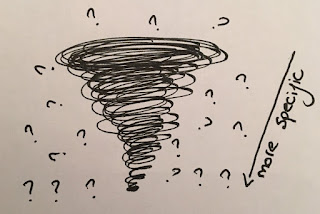
The Tornado of Truths
As a final talking point we considered the ethics. This lead to a great deal of confusion that we all quickly got sucked into, which was a bit unnecessary as it's not as complicated as we all think. Ethics is something that should be conducted throughout our inquiries, it's a process not a thing. The term 'an informed opinion' is how I've always thought of ethics - and coincidentally Amanda mentioned it. Low and behold that's exactly what it is, its the consideration of all aspects in relation to your questions. I drew a small diagram during the discussion to try and create a visual reference:


In relation to the tornado, what makes the smaller questions around it non-dangerous is its spin. The spin gives everything a relationship so you can approach them safely and with trust. If you don't research into why you have an opinion (so its not informed) then it could cause harm. How do the questions I'm asking inform my opinion - as the diagram shows. Recognise the ethics and articulate them.

As the session drew to a close, we were asked what we found most useful from the session. I found having actual people to talk to and discuss ideas with is invaluable. In discussion with Eleanor after, we both agreed it's difficult to keep a good conversation flowing on the blogs as you don't get a notification if someone has replied to your comment, so I really valued the time to talk to people. With that in mind, I would like to invite and encourage people to add me on Facebook if they want to further discussion or have ideas/questions. We all feel a little lost at times I think and having that reassurance can be helpful and aid your work ethic. Even if our questions/inquiries are different, a new person to give a different perspective can enhance our work and ideas further - it broadens our knowledge and there's no harm in that.